
Show Your Worth: Engineering Your Ascent with Shelmina Babai-Abji
with Shelmina Babai-Abji
About this episode
In this episode of Her Career Unplugged, Joanne and Vimala sit down with Shelmina Babai-Abji (bestselling author of Show Your Worth, former IBM Vice President, and founder and CEO of ShowYourWorth.ai) for a conversation packed with hard-won strategy. Shelmina traces her path from leaving home in Tanzania at 15 to becoming one of the highest-ranking women of color at IBM while raising two children alone, and breaks down the frameworks from her book that took her there: defining success on your own terms, feeding your "voice of courage" over your "voice of fear," building a leadership brand that isn't self-promotion, and knowing the difference between a mentor and a sponsor. She closes with a rapid-fire round covering the strategy most women skip, what to tell a woman passed over for a promotion, and the one thing that's stayed true across every chapter of her career.
Watch
Show notes
- Shelmina's origin story: leaving home in Tanzania at 15 to lift her family out of poverty, becoming the first in her family to graduate college, and rising to Vice President at IBM while raising two kids as a single mother.
- Why she initially settled for "incremental success", and the moment a mentor, Susan Whitney, asked her a single question ("Where do you want to be in five years?") that changed her career trajectory.
- Strategy one from Show Your Worth: define what success means to you personally, aligned with your own core values, not just the goals your boss hands you at the start of the year.
- The fear of speaking up as a young engineer surrounded by Ivy League PhDs, and how being "stuck between a rock and a hard place" forced her to create unique, hard-to-replace value.
- "Power quotient": Shelmina's term for your innate ability to choose an empowering response over a disempowering stimulus, and why that choice, not the stimulus itself, is what you control.
- Courage is not the absence of fear; it's doing what you must do despite it. Fear and courage are both voices in your head, and the one that grows stronger is the one you feed.
- Reframing leadership branding: it's not self-promotion, it's about becoming, day in and day out, the kind of leader you want to be known as when you're not in the room.
- Mentor vs. sponsor: both matter, but sponsorship (someone willing to put their credibility on the line for you) has to be cultivated early, before you hit the "messy middle" of management.
- How ShowYourWorth.ai turns her book's eight strategies into a 24/7 personalized AI mentor that remembers every conversation, tracks weekly reflection and celebration, and scales her mentorship to thousands of women (and now men) globally.
- Why reflection and celebration are the cornerstone of her framework; most high achievers move from success to success without stopping to build their "success muscle."
- Rapid fire: the strategy most women skip is self-care; mentors matter throughout a career but sponsors become critical at the middle-management "messy middle"; and the one constant across her journey from Tanzania to IBM VP to AI CEO, staying true to yourself.
About the guest
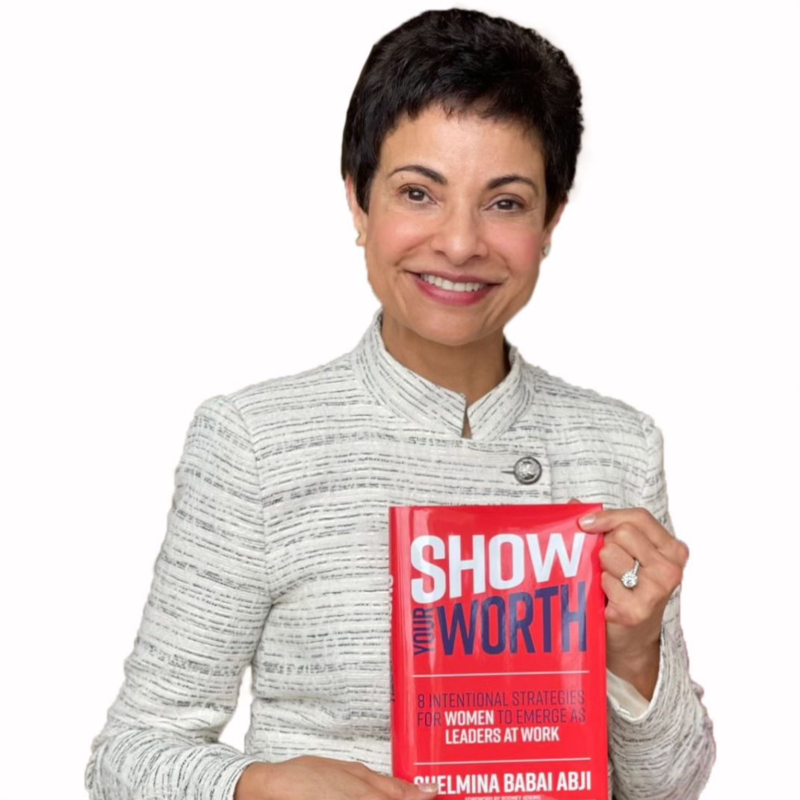
Shelmina Babai-Abji
Founder and CEO, ShowYourWorth.ai
Shelmina Babai-Abji is a former IBM Vice President, bestselling author of Show Your Worth, and founder and CEO of ShowYourWorth.ai, which offers personalized guidance to help professionals recognize and communicate their value at every career stage. Having risen from poverty in Tanzania to the executive ranks of IBM as a single mother, she is now a sought-after global speaker for organizations including Google, NASA, Microsoft, and Harvard, and a philanthropist funding education initiatives in Tanzania and Uganda.
Show full transcript
Vimala Pydi[00:00]
Welcome everyone to Her Career Unplugged. Today we have a guest that we are all super excited about, and we did use most of her strategies that she had. I'm kind of doing a spoiler alert here that she has in her book. Before that, I want to give a brief introduction of our guests. For this, I want you to just picture this: a 15-year-old girl packs her bag.
Vimala Pydi[00:27]
In Tanzania, she looks her future in the eye and makes a decision to change her family's history. No safety net, no plan B, just conviction so deep it could move mountains. I have a spoiler alert for you. She absolutely crushed it. She didn't just climb the corporate ladder, she learned how to engineer her assent. Every role she took, every challenge, every room she walked into.
Shelmina Babai-Abji[00:33]
So, I'm to
Vimala Pydi[00:55]
It became a data point for her. Over the years, she studied the career strategy. She studied how what works and what didn't. She went back and refined it, and she had something rare and powerful in her hands, a tried and tested playbook on how women can rise. That's exactly what we are here for this podcast, right? She just didn't rose to any levels. She was, she went all the way up to vice president at IBM.
Vimala Pydi[01:24]
One of the highest ranking women of color in the company, and also she was raising two kids. Solo. So nothing of this is by accident or by luck. She used a strategy and she made it happen. She looked at the playbook that she built over the years and she walked away from that corner office to kind of help to see how she can help many women of color and also like many women in their career.
Vimala Pydi[01:54]
And this is how Show Your Worth was born. Show Your Worth is a book that I kind of always use, and I have it right here for my career strategy. And Joanna and I, we both like go by that. So, ladies and gentlemen, today I have Shalmina as our guest. She's the founder and CEO of ShowYourworth.ai, an AI-powered personalized career guide that's a 24-star seven.
Vimala Pydi[02:22]
Strategic partner for women ready to grow and advance in their career. She's a best-selling author, a global keynote speaker, an angel investor, and a philanthropist, showing up to every role with the same fierce conviction she had at 15. She has graced a lot of stages. That's where I saw her first: at Amazon, Google, NASA, Howard, Microsoft, Meta, World Bank, and Grace Hopper. I did first see her at Grace Hopper. She delivered a
Vimala Pydi[02:52]
great speech that touched me personally, and she got a standing ovation, And that's not it. In her spare time, this woman does it all. She funded a secondary school in Tanzania serving 500 plus students, an early childhood education center in Uganda for 450 children, and also gives college scholarships for young women who dare to dream dream as big as she did.
Shelmina Babai-Abji[03:11]
So So.
Vimala Pydi[03:18]
Her message is very clear. Women belong in every room where decisions are made, and she's not asking for permission. So get ready because this conversation is going to challenge you, charge you up, and remind you that you never you have your next bold move coming up. It's already inside you. You just have to choose it. Welcome to her career on plug, Shalmeu.
Shelmina Babai-Abji[03:41]
It is such an honor to be here. Thank you for that very kind and generous introduction. I am looking forward to having a conversation and whoever listens to it takes the time to execute upon those strategies. I know we will change their career trajectories. So let's go.
Joanne Skiles[04:02]
wanna say thank you again for being here. I to echo what Vimila said. It is a huge honor that you are here. And there's so much that to unpack really even within the first chapter of your book. So we'll just talk right here. Like you grew up in Tanzania, and then I know y you went to college in another country, and then you came to the US, and then you became a single mother earlier in your career. And with all that, you are
Joanne Skiles[04:28]
one of the highest ranking women of color at IBM. So what's that one moment that made you believe you could actually go all the way?
Shelmina Babai-Abji[04:37]
You know Joanne, I wish there was just one moment. There were so many moments. There were so many moments. Each moment built on each other.
Shelmina Babai-Abji[04:52]
I had a lot of self doubt, so many self limiting beliefs. I came from very humble beginnings. I was the first person in my family to graduate college. When I entered corporate America, I knew nothing but had a degree in computer science. So I knew how to write code. That's all I knew. And so this is why I am passionate about what I do is I had to learn.
Shelmina Babai-Abji[05:21]
everything. I had to learn everything and that's why I'm able to teach everything. Nothing just came to me naturally. And so there were many moments and each moment unfolded more moments. What I did is I showed up. Not only did
Vimala Pydi[05:33]
There many moments and each moment unfolded more moments. What I did is I showed up.
Shelmina Babai-Abji[05:43]
I show up, I showed up intentionally. I showed up strategically. I showed up
Vimala Pydi[05:44]
I showed up.
Shelmina Babai-Abji[05:50]
to contribute, I showed up to learn. I showed up and I gave it my best shot. And that's how these moments kept, they kept unfolding. And each moment became a teacher.
Joanne Skiles[06:08]
Yeah. I love it 'cause like you said, you had to live the experience.
Shelmina Babai-Abji[06:13]
Yes.
Joanne Skiles[06:13]
Yes. And I guess with that is at what point going through and living these experiences did you I mean you said you became a teacher. So what made you decide to say, All right, I'm gonna teach and write this down and let others
Vimala Pydi[06:28]
gonna
Joanne Skiles[06:30]
learn?
Shelmina Babai-Abji[06:31]
That came really later. Initially, I had to learn it all. And I had to
Vimala Pydi[06:32]
teach and write this down and let others learn. That came really later.
Shelmina Babai-Abji[06:38]
use all the learnings for my own advancement. And I learned
Vimala Pydi[06:42]
You know?
Shelmina Babai-Abji[06:43]
not just as an individual contributor or someone who is climbing the corporate ladder, but I also learned as a leader, as I watched people that worked for me, what about them that made them stand out.
Shelmina Babai-Abji[07:00]
What about them made them essential to my success, to the success of their organization? So I learned from my own journey, but I also learned from journeys of other people that I was fortunate enough to witness. And initially it was, as you heard Vimala say, at 15 I left my home because I wanted to lift my family out of poverty. My mom used to cook for other people.
Shelmina Babai-Abji[07:30]
and we would sell food on the streets to make ends meet. And it was painful as a young child watching my mother work so hard. And I was convinced that if I got a college degree, then I would make enough money so my mom wouldn't have to work as hard. That was my initial inspiration. And that is what drove me to leave home at the age of 15. Even though my parents didn't even own a phone, there was no way for me to
Vimala Pydi[07:36]
watching my mother work so hard. I was convinced that if I that I would miss enough money so my mom would have that was my initial instinct. And that is what drove me to leave home at the age of fifteen, even though my parents didn't even order. There was no way
Shelmina Babai-Abji[07:59]
get to them. But yet my calling to lift
Vimala Pydi[07:59]
for me to get to them. But yet cover
Shelmina Babai-Abji[08:04]
our family out of poverty was so intense that whatever challenges came my way, they seemed pale compared to what I could achieve. And so it just became one of those things where you start somewhere and then you end up somewhere and you learn more.
Shelmina Babai-Abji[08:24]
So initially I was driven to lift my family out of poverty to send money to my parents so that my mom didn't have to work so hard. And that is what got me started. However, while I was working, I started learning more about myself. I started learning more about the corporation. And I was very, very fortunate that while there were a lot of naysayers,
Shelmina Babai-Abji[08:52]
because they had never seen anyone that looked like me in any roles that I had or aspired to have. There were a few people that took a chance on me. There were a few people that gave me feedback, that mentored me, that guided me. And they played a significant role in my ascent. And then, Joanne, I got to a point where I had achieved so much.
Shelmina Babai-Abji[09:21]
and I wanted to pay them back. And that's when I started paying forward. That's what got this whole process of sharing what I had learned with others so I can be an instrument to help them grow and advance in their careers, just as someone else had been an instrument to help me, whether it was in my personal life,
Shelmina Babai-Abji[09:50]
with my mom, for example, or in my professional life, my mentors, my sponsors, my leaders, my peers who took the time to give me feedback, who took the time to teach me something that helped me advance.
Joanne Skiles[10:08]
I think there's really something I wanna double click on is that you said that you also got a lot of experience from when you were a manager leading others and seeing that their backgrounds, because they had different backgrounds from you as well, that also shaped your experiences. And I think just the same way that you got help.
Joanne Skiles[10:29]
from others from mentors and peers, you also helped in those beginning parts before you wrote a book and everything, helped others and shaped their careers, which then helped you. And I love that
Shelmina Babai-Abji[10:40]
Yes, yes, yes.
Joanne Skiles[10:42]
because it's the a relationship is two people building onto each other. Right. Yes.
Shelmina Babai-Abji[10:46]
Yes, yes, yes.
Joanne Skiles[10:49]
And that's that's what's important and extremely valuable
Joanne Skiles[10:55]
and we'll go further on into that later on, but I wanna make sure that we highlight it right now, how important it is not just to be mentored, but to
Joanne Skiles[11:05]
be a mentor. It helps you both ways. And I I can
Shelmina Babai-Abji[11:05]
Yes, yes. Yes, yes.
Joanne Skiles[11:09]
say that from my own experiences as a manager when I was when I was manager is that it also helped me with my own growth.
Shelmina Babai-Abji[11:17]
it does.
Joanne Skiles[11:19]
So
Joanne Skiles[11:22]
there are eight strategies within your book. and the first strategy is defining what success means to you. And I think it's really important because success is different for everybody. The definition of success can be for some money, for others, it's how well you're getting in a certain point in your career, and your success can change over time, your definition of success.
Joanne Skiles[11:49]
How many women do you think have actually done that work before they're already really like ten, fifteen years into their career?
Shelmina Babai-Abji[11:57]
Yeah, so, you know, it's a spectrum. It's really hard to generalize and say 10 % of the women have done this work. I learned based on my experience, most of us are driven by external circumstances. So there's that group of women who show up to work and
Shelmina Babai-Abji[12:18]
they essentially deliver what is expected of them. So that becomes their definition of success. At the beginning of the year, your boss sits down with you and says, this is what we expect of you. And you make sure that you deliver on that. Now, there's nothing wrong with that, Joanne, but when you do just that, you achieve what I call incremental success.
Shelmina Babai-Abji[12:46]
you are driven by the goals of your organization and your boss, which should be a subset of what should be driving you, not the entire thing. Very few women drive their own success. Very few women are proactively and intentionally and strategically defining what success means to them. And of those few women, many women
Shelmina Babai-Abji[13:15]
are settling for what again I call incremental success because we have a tendency to define success based on what we know we can achieve because we don't want to disappoint anyone else nor do we want to disappoint ourselves but if we only push ourselves to what we know we can deliver we are shortchanging our success
Joanne Skiles[13:43]
Yes.
Shelmina Babai-Abji[13:43]
and that's why
Shelmina Babai-Abji[13:44]
In that chapter, first and foremost, I tell women, you must define what success means to you personally. And as you said, you can get guidance from others, but don't be driven by others because even when you achieve somebody else's vision of success for you, it will ring hollow. But when you are driven by your own internal compass, not only will you feel successful,
Shelmina Babai-Abji[14:14]
but it becomes this internal compass that drives you day in and day out. It becomes your barometer for every decision you make. It becomes your fort, your rock when things get challenging because you have decided that this is what success means to me. Just as I had decided lifting myself out of poverty was what mattered the most.
Shelmina Babai-Abji[14:40]
And so no matter what came my way, I figured out a way to overcome and to remain on track. So it's not just about overcoming challenges, but it is about remaining on track week after week after week, pursuing what success means to you. So aim high. It's better to aim high and not reach that destination and yet have the journey transform you.
Shelmina Babai-Abji[15:09]
instead of aiming low and achieving it easily. So I ask women to define success, something that scares you, something that you don't even know you can achieve, and then get the right support and do your very best to get there. Because no matter what you achieve, your starting point for your next definition of success will be higher. So it's a long journey.
Joanne Skiles[15:38]
yeah.
Shelmina Babai-Abji[15:38]
Your
Shelmina Babai-Abji[15:38]
career is a long game. Every success will build upon and create future success. And so it's really important to aim high. And I'll share a small story with you here, Joanne, is I was inadvertently settling for small success because for me, all I wanted to do was lift my family out of poverty. So when I was making $40,000 a year,
Shelmina Babai-Abji[16:07]
as a systems engineer, I was extremely content. I thought I was highly successful based on my frame of reference, based on where I came from, I was highly successful. So I wasn't really looking at my future potential until I won an award. And I start the chapter with that experience. I won a highly coveted award. It was called a...
Shelmina Babai-Abji[16:36]
Rookie Systems Engineer of the Year Award. I was invited to a Women's Roundtable, Susan Whitney, who eventually became my mentor for 20 plus years. She was a high-ranking IBM executive from Chicago, visiting Minneapolis, where I used to work for at IBM. And I sat in that room with high-achieving women, still not sure whether I belonged in that room or not.
Shelmina Babai-Abji[17:05]
And then I went to this recognition event because of that achievement for the first time in San Francisco, five star hotels, drinking fine wine, eating sushi for the first time, still wondering if I belonged there. what Susan did after that round table, I was supposed to walk her from my, from that meeting to my boss's boss's office, two minute walk.
Shelmina Babai-Abji[17:35]
She changed my career trajectory. She looked at me and she says, congratulations, Shalmina, for winning such a highly coveted award. And Joanne, I was like a child. I'm thinking, wow, she knows my name.
Shelmina Babai-Abji[17:51]
And I could barely even say thank you. And then just as casually as you would ask someone about their restaurant preference, she goes, where do you want to be in five years? I looked at her a glazed look in my eye because I had never thought about it. And I said, Susan, I've never thought about that. I don't know. I said, I get so busy doing the best possible job in my current role that I haven't really thought about.
Shelmina Babai-Abji[18:21]
what I want to do in five years. And what she said next changed everything. That was the first change. She said, Shalmina, it is critical that you do the best possible job in your current role. And it is equally critical that you know what you want to do next and next.
Joanne Skiles[18:46]
Mm-hmm.
Shelmina Babai-Abji[18:47]
That way you're always working towards something bigger.
Shelmina Babai-Abji[18:52]
you have so much potential. And that was it. And my mind went into a tizzy because I didn't know what that really meant, but she planted a seed and I'm thinking to myself, if she thinks I have potential, I must have potential because I was in awe of her.
Shelmina Babai-Abji[19:16]
And that's what got me going. That made me aim higher because I believed I had potential. And so I ask women to aim high, to believe that you have potential. Cause if we don't believe that we have potential, the world takes us at our own estimate. They won't believe we have potential. So it starts with you. I was lucky Joanne
Joanne Skiles[19:44]
Yeah.
Shelmina Babai-Abji[19:44]
that
Shelmina Babai-Abji[19:45]
Susan saw potential in me. And now I want to be that instrument that sees potential in other women, that gets other women to see potential in themselves. The second thing I ask in that chapter of defining success is to align your success with your core values. Because as I mentioned earlier, our career is a long game. If what you are doing
Shelmina Babai-Abji[20:15]
and how you define success is not aligned with your core values, you're gonna give up at some point.
Shelmina Babai-Abji[20:25]
because things will get tough and things should get tough. If
Joanne Skiles[20:27]
Yeah. Yes.
Shelmina Babai-Abji[20:29]
you define success by aiming high, you should expect things to get tough. And that's a good thing for you because when it becomes challenging, that's when you dig deep. That's when you really show up to solve those problems, to overcome those challenges. So this first chapter sets the compass.
Shelmina Babai-Abji[20:55]
the direction. And every chapter after that accelerates your journey towards your vision of success.
Vimala Pydi[21:06]
Yeah, I do want to add the first chapter was an eye opener for me. I'm like not I'm at like my end of career pretty much, as a senior. And looking at the first chapter, that was something that I didn't do when I started my journey. as you said, like as a first generation immigrant into this country, it is pretty much go, go, go. And there is always that fear that if you
Vimala Pydi[21:35]
don't get your goals that your organization is setting, you may lose your job. There are so many inhibitions that are within us. So that's a really good lesson to have both of them in your vision, peripheral vision, on setting your goals and also working and aligning yourself to your organizational goals. That's that was the eye opener for me, for sure. I hope our listeners can take that.
Shelmina Babai-Abji[22:02]
Thank you.
Shelmina Babai-Abji[22:04]
Thank you, Vimala. And this is why this work, I'm so passionate about this, is because I feel like the universe put the right people in my path at the right time to teach me.
Shelmina Babai-Abji[22:16]
to get me to think differently because I was also inadvertently settling for small success. was also, I wasn't necessarily fearful of losing my job. And interestingly enough, the company did shut down. So we did lose the job. But my initial fear, as you will see in the chapter of intentional value creation, was this fear of speaking up. And...
Shelmina Babai-Abji[22:44]
That was because I started comparing myself. So when I joined my first job, I was on a student visa. And so I had this one year practical training visa and no one would hire me because I didn't have the right visa status. And I went to a small no-name university, so no one came to our university to hire students. And so I went to a conference to find a job.
Shelmina Babai-Abji[23:12]
And for the first two days, no one would even speak to me. I had handed out over 300 resumes and cover letters in those days, but no one would speak to me. Even though I was on the Dean's list, I had worked 35 to 40 hours a week in addition to a full computer science workload to pay for my college. The reason they didn't hire me is because I didn't have the right visa. But then on the last day, a technology startup company hired me.
Shelmina Babai-Abji[23:42]
And when I showed up to work, I was the only woman of color in a company of mostly engineers, 2000 of them. And I started looking around and all these people, had masters, PhDs from MIT, Carnegie Mellon, Harvard, Yale, Urbana-Champaign. And I'm thinking to myself, wow, what do I know that they don't already know?
Shelmina Babai-Abji[24:12]
I immediately started undermining my capabilities, underestimated my worth. That's why the title of the book and all my work is show your worth because we are all worthy. We just forget that it's hidden underneath
Vimala Pydi[24:26]
Right.
Shelmina Babai-Abji[24:27]
layers and we have to really peel the onion to get to our worth and continue to grow it. And
Vimala Pydi[24:33]
Yeah.
Shelmina Babai-Abji[24:34]
so that belief that my ideas won't matter, that everything
Shelmina Babai-Abji[24:41]
I know they already know, instilled fear of speaking up. And so while I did a really good job as a programmer, poured my heart and soul into making sure that, you know, I achieved every KPR and whatever my boss was expecting of me, I was afraid to speak up. But I was stuck between a rock and a hard place. I'm afraid to speak up. And yet I knew within one year, if
Shelmina Babai-Abji[25:09]
I did not make myself difficult to replace, then by law, they were required to hire someone with the right visa. And so this is why when I look back at my career, I feel that every experience was given to me so I could do this work. That being stuck between a rock and a hard place forced me to overcome my fear of speaking up. It forced me.
Shelmina Babai-Abji[25:39]
to speak up, create unique value, which could not be easily replaced by anyone else. Because without that, I would have to go back to Tanzania and could not lift my family out of poverty. That is what drove me. That was my definition of success. It wasn't about getting promoted. It wasn't about seeking visibility.
Shelmina Babai-Abji[26:06]
It wasn't about creating impact and influence. All that came later. It was about lifting my family out of poverty. But that driver was so strong and I faced so many challenges along the way that it taught me. I learned, I grew. And so that fear of
Shelmina Babai-Abji[26:28]
Speaking
Shelmina Babai-Abji[26:28]
up, how to show up, how to create value, how to ensure that you become essential to the success of your organization. Vimla, you talk about fear of getting laid off. Someone recently asked me, how do you become unfirable? And I said, you don't become unfirable. Everybody is dispensable, right? But what you
Vimala Pydi[26:52]
That's true.
Shelmina Babai-Abji[26:53]
do become is essential to the success of your organization.
Joanne Skiles[26:57]
Mm.
Shelmina Babai-Abji[26:57]
That
Shelmina Babai-Abji[26:58]
way you won't get fired because they need you more than you need them. Right. Right.
Joanne Skiles[27:03]
Yep.
Shelmina Babai-Abji[27:03]
But we work in fear. We work in fear.
Vimala Pydi[27:06]
Yeah, yeah.
Shelmina Babai-Abji[27:07]
And working in fear shortchanges our ability to show our worth. Yes.
Joanne Skiles[27:13]
Yes.
Shelmina Babai-Abji[27:14]
So I think
Vimala Pydi[27:14]
Totally agree. Yeah.
Joanne Skiles[27:19]
You answered so many questions that I had lined up. So it's just it's just amazing at this point. I think at this point we get here, we have to speak up. We have to and we've said this before in other episodes, is you have to be comfortable being uncomfortable. Like it is important. That's how you grow yourself, that's how you challenge yourself. So
Joanne Skiles[27:43]
the question leadership branding makes a lot of women uncomfortable because it sounds a lot like self-promotion. So how do you reframe it from that urge to keep your heads down? And I think you've kind of already said it a lot. I just want to hear it like really clearly for everybody, to let them know that, you know, don't let don't keep your head down and ha let the work speak for yourself. How do you reframe it for women to understand that it's not self-promotion?
Shelmina Babai-Abji[28:11]
Yeah, see, leadership branding is not about self promotion at all. Not at all. So anyone who thinks
Shelmina Babai-Abji[28:20]
That leadership branding is about self-promotion. I challenge that assumption because it's not. Leadership branding. So, first of all, branding, your brand is what people say about you when you're not in the room. Do you want people to say that she has her heads down and just works all the time? Because every impression you leave behind is forming your brand. What I teach women.
Shelmina Babai-Abji[28:50]
is to create a leadership brand. And and let me peel that onion. And I also want to go back to you you talked about getting comfortable being uncomfortable
Shelmina Babai-Abji[29:01]
And we were talking about fear. So
Shelmina Babai-Abji[29:03]
Courage is not
Shelmina Babai-Abji[29:04]
the absence of
Shelmina Babai-Abji[29:05]
fear.
Shelmina Babai-Abji[29:06]
Courage is doing what you must do even though you're afraid. But here's the trick.
Shelmina Babai-Abji[29:14]
Every time you feed your voice of courage, you see, fear and courage are voices in your head. The voice that tells you, don't do this, it's trying to protect you. That's fear. But the voice of courage would be the one that tells you, Vimla, do it, because it feeds you your definition of success. So in my case, when I was afraid to speak up.
Shelmina Babai-Abji[29:40]
My definition of success of lifting myself out of poverty is what helped me feed my voice of courage. Speak up. If you create unique value, you will become difficult to replace. So you won't have to go back to being poor. That gave me the courage to speak up. And so what happens is every time you feed your muscle of courage, your voice of courage.
Shelmina Babai-Abji[30:10]
That keeps getting stronger and stronger and stronger, and your voice of fear keeps getting weaker and weaker and weaker. They both coexist. These voices in your head coexist. There is the voice of fear, there is the voice of courage. The voice that wins is the voice that you feed. So if you keep feeding your fear, like I did initially, because fear would say, they already know everything you have.
Shelmina Babai-Abji[30:40]
To say, and then I'd be quiet. Now my voice of fear was getting louder and louder and louder. But then when I started feeding my voice of courage, even though the voice of fear was ringing loud, I fed my voice of courage. And it started getting louder and louder and louder. Over time, they still coexist.
Shelmina Babai-Abji[31:07]
But fear has no chance because it you have weakened it, choice after choice after choice. So it is up to us on whether we want fear to become bigger or courage to become bigger. And this happens by the choices we make. Which voice are you going to feed?
Joanne Skiles[31:32]
I love it. I love it.
Vimala Pydi[31:34]
Yeah, love it actually.
Shelmina Babai-Abji[31:36]
So
Joanne Skiles[31:36]
Mm.
Shelmina Babai-Abji[31:37]
leadership branding is not about self-promotion at all. Anyone listening, thinking that leadership branding is about self-promotion, I challenge that assumption. I challenge the assumption because leadership branding.
Shelmina Babai-Abji[31:56]
Is not about self-promotion at all. Leadership branding is your brand, first of all, is what people say about you when you're not in the room. Every impression you leave behind is creating your brand. Most of us inadvertently, unintentionally create a brand that works against us. So what I am teaching women to do is I am asking women to build.
Shelmina Babai-Abji[32:26]
Leadership brand to figure out what are the attributes of leaders that you admire, that you respect, and you become that person. You see, leadership branding or branding of any sort is not about pretending to be what you want to be talked about. Because when the environment gets tough, the masks fall off. So you have to become that person.
Shelmina Babai-Abji[32:53]
You have to show up as that person day in and day out with every impression you leave behind. That is leadership branding. It has nothing to do with self-promotion. It has everything to do with how you show up.
Shelmina Babai-Abji[33:12]
Because every impression you leave behind is forming a leadership brand. So when we would have conversations about people in a room where they were not present, who gets how much salary increase? Who gets how many stock options? Who gets the next plum assignment? None of those people were in the room, but their brand was in the room. What people said about them informed our decisions.
Joanne Skiles[33:41]
Yeah.
Shelmina Babai-Abji[33:41]
And so
Shelmina Babai-Abji[33:42]
what I'm asking you to do, and which is what I also learned to do, is what do I want people to say about me when I'm not in the room? I will become that person. But you become very intentional about who you want to become and why.
Shelmina Babai-Abji[33:59]
And when you have that figured out, you grow into the leader that you respect, that you admire. And that's what personal leadership branding is all about.
Joanne Skiles[34:15]
Yes. And it's very much on point because
Vimala Pydi[34:20]
Yep.
Joanne Skiles[34:21]
you're n the moment where decisions are gonna be made about you, most of the time, is when you're not in the room. So So you gotta you gotta have something so people go,
Shelmina Babai-Abji[34:29]
Absolutely. I'd I'd say all of the time. Yeah.
Vimala Pydi[34:30]
Yes, I totally agree.
Joanne Skiles[34:34]
I know I know who she is.
Shelmina Babai-Abji[34:38]
And it's not just about I know who she is. It it's important for people to know you, but how you are known is the difference maker. Yeah.
Joanne Skiles[34:47]
How they know you. Yeah. I know who she like what she stands
Vimala Pydi[34:48]
No.
Joanne Skiles[34:50]
for, what she does, what what what how she that but is. Not who she is, but I don't know. I know who Joanne is. I'm like, I'm a loud mouth. Everybody knows who Joanne is. but but do you know Joanne? That is the question there. In how do you know me as a
Shelmina Babai-Abji[35:05]
Yeah. How do you know Joanne? Yeah. So
Vimala Pydi[35:07]
Yeah. How do you know that?
Joanne Skiles[35:09]
hands-on technical person.
Shelmina Babai-Abji[35:12]
So so the two things to keep in mind is who knows you and how you are known. So you have to be very strategic. What I teach women is to be strategic and intentional. You have to be very strategic about which people you want to make sure know you. Who are the influencers? Who are the decision makers? How do you
Shelmina Babai-Abji[35:41]
Get them to have front seat and have you have the visibility to those people, the people that matter. So who knows you is extremely important, and then how you are known is equally important because the decision makers and influencers may know you, but they don't know you with the right attributes
Joanne Skiles[36:07]
Yes.
Shelmina Babai-Abji[36:08]
that are required for you.
Shelmina Babai-Abji[36:11]
to get to what you want to do next and next. You see how all of this is tied together? Each
Vimala Pydi[36:18]
Yes.
Shelmina Babai-Abji[36:18]
strategy is a link in a chain.
Joanne Skiles[36:22]
Yes.
Shelmina Babai-Abji[36:23]
You could
Vimala Pydi[36:23]
Right.
Shelmina Babai-Abji[36:24]
create value at your maximum capacity, but if your value does not have the visibility with the right people, it's not going to go too far.
Shelmina Babai-Abji[36:35]
Right. So you create value at your maximum capacity, you build the right relationships that will support your career. And you are known for the right reasons that will take you to what you want to do next and next. And this is what you have defined as your vision of success. This is what becomes the ammunition for your voice of courage.
Joanne Skiles[37:03]
Yes.
Shelmina Babai-Abji[37:04]
It's
Shelmina Babai-Abji[37:05]
it all ties together and it creates an upward spiral for success.
Joanne Skiles[37:13]
Yes. It's it's
Vimala Pydi[37:14]
Yeah.
Joanne Skiles[37:15]
amazing advice and this is I will say not to over exaggerate, pure gold. And extremely validating. Totally humble there, but extremely validating
Shelmina Babai-Abji[37:22]
Yeah, yeah. And and
Vimala Pydi[37:23]
It is, it is, yeah.
Joanne Skiles[37:27]
too and I love it.
Shelmina Babai-Abji[37:28]
100%. And I'm not at all ashamed to say anyone who has read my book and executed even one of the strategies, their career trajectory has transformed. So reading the book will do nothing if you don't change. Because
Joanne Skiles[37:45]
Mm-hmm. Yes.
Shelmina Babai-Abji[37:46]
if you don't change, nothing changes. But
Joanne Skiles[37:48]
Exactly.
Shelmina Babai-Abji[37:49]
if you read the book and you change the way you show up, even if you change one strategy.
Shelmina Babai-Abji[37:57]
it will change your career trajectory. If you add all the strategies slowly, it's a lot of work. You will be on an upward spiral and unleash your maximum value, realize your maximum potential.
Joanne Skiles[38:16]
I love it. before I hand you over to Vimela and get unplugged, I do want to give you a chance to talk about what you're doing right now. So you went from
Shelmina Babai-Abji[38:25]
Yeah, yeah.
Joanne Skiles[38:27]
IBM VP to book offer to now running, show your worth AI. So what does it actually do and who is it for?
Shelmina Babai-Abji[38:35]
Yeah. You know, just as my career, with every level of success I achieved, more possibilities opened up. Just like that, I left corporate America to help a few women become successful. And when I couldn't take on any more mentors, it would hurt me because I would keep thinking, what if that's the young Shalmina? And what if someone didn't mentor me? And that's why I wrote the book.
Shelmina Babai-Abji[39:05]
The other reason is as I was mentoring hundreds of women and I sat on a couple of boards, I learned that they were struggling with the same things that I had struggled with 30 years ago, 20 years ago, 25 years ago. So in my mentoring, they helped me understand what their struggles were. And so that has also contributed to the book. And in the book, I actually say, I will be your mentor. You have to do the work. And so the book came out.
Shelmina Babai-Abji[39:34]
I thought the book would solve the problem and it will mentor as many women as they look as as many women who are looking for me to mentor them, the book will mentor them. As the book became a bestseller, and as my speaking engagements grew, Vimla, you heard me at the Grace Hoppers Conference in 2024. I this book actually made the problem bigger because now I was visible to more women.
Shelmina Babai-Abji[40:03]
And so instead of getting three mentoring requests a month, I started getting 30, sometimes 300, depending on where I was speaking. And after the women read the book, they would reach out to me and their request would be I have never read a book like this before. Because I teach you how I learned about the strategy. And people are able to see themselves in my struggles. And then of course I teach you not just to overcome your struggle.
Shelmina Babai-Abji[40:31]
But to actually use it to grow and to move forward. So the struggles are actually a blessing. Challenges are a blessing for you to learn, grow, and become more successful in the future. And so the women would say, I've never read anything like this, but I have a personal situation. Will you be my mentor? And just as that was going on, AI came to the forefront.
Shelmina Babai-Abji[41:01]
And now AI is allowing me to use my book, to use my own self in the way I mentor women, to teach AI how I mentor women, and to understand every woman, her struggles, her strengths, her weaknesses, her dreams, her definition of success. So I am able to hold your hand every step of the way.
Shelmina Babai-Abji[41:30]
In the book, you answer the questions with the AI. I help you answer the questions. And then based on your responses, AI creates a personalized guidance, meets you where you are, understands your current state, helps you execute and apply the eight intentional strategies. And I work with you 24 by seven. Whatever you need, I am with you.
Shelmina Babai-Abji[42:00]
In a very personalized manner, because AI doesn't forget anything. AI doesn't judge. And so I tell my mentees that my AI platform is even a better mentor than I was, because I, as a human being, do not remember every conversation I had with the thousand mentees I had.
Shelmina Babai-Abji[42:24]
But AI doesn't forget. And so it has become a very powerful way for me to increase my impact exponentially for women and now men globally, meet them where they are, hold their hand, and take them through the eight strategies. Help them define their vision of success. Help them build their own personal success plan.
Shelmina Babai-Abji[42:54]
And most importantly, every week, just as I ask you in the book, you can reflect and celebrate with me. So together we remember your successes. So I will remind you of your success when you have forgotten what you achieved. It's very powerful.
Joanne Skiles[43:15]
Yes. I forget a lot of my successes. I and as as is
Shelmina Babai-Abji[43:18]
We all do.
Joanne Skiles[43:19]
human, because we get focused I and I'll say it this way, I I've told Vimela before is I'm a hyper achiever. So my biggest problem that I have is once I achieve something, I'm only thinking about the next achievement and and so I never remember to celebrate. And that that's always been my biggest challenge. So it's wonderful to see like the reminder of like when
Joanne Skiles[43:38]
You don't hit the achievement, it kind of feels bad, right? So it's that remindment of look of all the stuff you have done though.
Shelmina Babai-Abji[43:45]
Yes, yes.
Vimala Pydi[43:45]
Yeah, but
Shelmina Babai-Abji[43:46]
And in that the reflection and celebration is the cornerstone of my success, cornerstone of my book, and cornerstone of my AI platform. Because Joanne, most women are like you. We go from success to success to success, but we don't stop to celebrate. And if you don't stop to celebrate, you are not building your success muscle.
Shelmina Babai-Abji[44:10]
And so the weekly reflection and celebration serves multiple purposes. The first one is you look back, you learn, you course correct, because it is a journey of learning and growing. Most importantly, you celebrate your successes no matter how small. And now this gets documented. So you have proof of your progress week after week after week.
Joanne Skiles[44:38]
Wonderful. Well, I am done asking questions. I'm gonna hand you over to Vimela and we are going to do our rapid fire section. So Vimela, take it away.
Vimala Pydi[44:51]
Thank you so much, Shalina. I just want to plug in the AI that I've used, your AI platform as well. And most importantly, celebrations, successes, and also it kind of helps you execute, which I feel most of the women kind of fall short
Shelmina Babai-Abji[45:05]
Yeah, I that's a good idea.
Vimala Pydi[45:08]
of. So that kind that gives us a way to execute, remember, go through those strategies. Iterate on it as well. So thank you for that.
Vimala Pydi[45:18]
And we are really blessed that you took this upon you to kind of mentor everyone as you with your story. Every one of us are not as lucky as you got your first mentor who changed your life. but I feel like with your calling, we all are blessed to kind of know those strategies and also use them. So thank you.
Shelmina Babai-Abji[45:39]
And you're doing your part because
Shelmina Babai-Abji[45:42]
what you are doing will take the message to more women. Together, our impact increases. So
Vimala Pydi[45:51]
Yeah.
Shelmina Babai-Abji[45:52]
So don't shortchange yourself either.
Vimala Pydi[45:55]
Will do. We want to be force multiplier, and that's our shared goal here to help women unplug their we kind of really go in, talk unplugged, and help them build their playbooks. So thank you. And yes, that's a shared goal. So the next one is going to be quick. it's more of a fun rapid fire. We call it as rapid fire unplugged. You can give us
Vimala Pydi[46:19]
short as one word answers or if you feel like you're going to give something of value, you can go a little longer. It's going to be quick, quick questions. So are you ready to get unplugged? All right.
Shelmina Babai-Abji[46:30]
Yeah, let's do it.
Vimala Pydi[46:31]
All right. The first one, the strategy most women skip entirely. Which one is it?
Shelmina Babai-Abji[46:38]
Work life balance and in particular self care.
Joanne Skiles[46:43]
Yes.
Vimala Pydi[46:43]
Totally agree.
Vimala Pydi[46:44]
The second one is tricky, mentor or sponsor. who do you think is important? Both.
Shelmina Babai-Abji[46:49]
Both. Both. They're they're both
Shelmina Babai-Abji[46:52]
important. Sponsors become more important when you want to move from an executive level to a senior executive level. or sometimes even moving to. So mentors are really, really important throughout your career. But you don't necessarily need a sponsor until you get to middle management. with women, we have this what we call a messy middle.
Shelmina Babai-Abji[47:18]
And the reason we have messy middle is because so many women are stuck in this mid-level management position. And the reason they're stuck in those positions is because they don't have a sponsor. Someone who will put their credibility on the line and recommend them for a role. If you have not cultivated that, by the time you get to middle management, it's too late. So so sponsorship has to be earned and cultivated early in your career.
Shelmina Babai-Abji[47:47]
So they come in handy when you need them.
Vimala Pydi[47:51]
That's a great tidbit there. All right. the next one is going to be you have thirty seconds with a twenty-five year old woman. just added that in because it's usually the start of career. And the woman is woman of color who just got passed over for a promotion she deserved. What do you say?
Shelmina Babai-Abji[48:11]
Yeah. So first and foremost is take a chance on yourself. Never, ever, ever, ever, ever give up on yourself. So if you got passed over for a promotion, the first thing I'm gonna ask is what can you learn from it? Because it is so easy to point the finger out and that doesn't help you.
Shelmina Babai-Abji[48:37]
Every experience is an experience to learn and grow. A good one, a bad one, and everything in between. And so the first thing I will ask is what can you learn from this? And take that learning for the next one. Because your career is a long game. One promotion does not get to define you unless you let it define you. If you didn't get a promotion, it doesn't mean you're a failure. Ask why you didn't get it.
Shelmina Babai-Abji[49:06]
And not in a confrontational way. I teach this in my book. Perhaps someone else did deserve it more. You may think you deserved it, but perhaps someone else did deserve it more. Or perhaps you did deserve it, and then the decision you make is go somewhere else. You're not worthy here. They're not appreciating what you bring. So you it's not a one size fits all. But every experience should be one in which you learn.
Shelmina Babai-Abji[49:35]
And you grow to make better future decisions.
Vimala Pydi[49:43]
Yeah, the next one is something like we all might have seen in our careers. What's something women are told is professional that's actually just make yourself smaller. They say
Shelmina Babai-Abji[49:56]
Why do you listen to those people?
Joanne Skiles[49:58]
why I have orange hair.
Vimala Pydi[49:59]
Yeah. Who cares, right? Yep.
Shelmina Babai-Abji[50:02]
You
Shelmina Babai-Abji[50:02]
get to you get to choose who to listen to and who not to. It's our choice. People can say and do what they want. You don't have to react. So there's this concept of power quotient, which we never discussed, but one of the most important concepts in my book, it's a term that I have coined, and I hope you put it somewhere in the podcast. As women,
Shelmina Babai-Abji[50:32]
As you define success that pushes you outside your comfort zone, you will encounter many people in many circumstances which will turn into disempowering stimulus. And then you have a choice. Are you going to give in to them or are you going to intentionally pick an empowering response and educate them? Always pick the second.
Shelmina Babai-Abji[50:57]
Your power quotient is your innate ability to pick an empowering response to a disempowering stimulus. And your definition of success allows you to pick an empowering response every single time.
Vimala Pydi[51:17]
Absolutely correct. I totally agree with you. so the last question here. you've been from Tanzania to IBM VP to AI CEO. What's the one thing that was true the whole time that stuck with you?
Shelmina Babai-Abji[51:34]
What's the one thing being
Vimala Pydi[51:36]
Yeah.
Shelmina Babai-Abji[51:37]
true to myself?
Vimala Pydi[51:38]
Absolutely.
Shelmina Babai-Abji[51:41]
That self-knowledge,
Shelmina Babai-Abji[51:43]
that's why every chapter has introspection. That self-knowledge makes you unshakable and unstoppable. Always be true to yourself.
Joanne Skiles[51:56]
Yeah.
Vimala Pydi[51:56]
Totally
Vimala Pydi[51:56]
agree. Yeah. Stay authentic. Stay truthful to yourself. Thank you so much, Shamina. get your show your worth.
Vimala Pydi[52:03]
Book and also check out her AI platform as well. We are so honored to have you on our talk today. And also for our listeners, please do subscribe to our channel. definitely check out Shermina's book. It's available on all the platforms. You can find it on Amazon.
Vimala Pydi[52:22]
Also check out her Show Your Worth AI platform as well. Any parting words, Shalmina, before we close out?
Shelmina Babai-Abji[52:31]
I want to thank you, and I want to thank the audience for taking the time to invest in themselves and to truly go out and show their worth. Each one of us is show worthy. Each one of us is worthy.
Shelmina Babai-Abji[52:47]
And when we embark upon that journey, we will surprise ourselves just how far we can go. And so let's go do this. Let's represent, let's be in those rooms where big decisions are made and let's go change the world, literally.
Joanne Skiles[53:04]
Yes. Thank you.
Vimala Pydi[53:04]
thank you everyone. So stay
Vimala Pydi[53:06]
bold, stay connected, and stay unplugged.