You Belong Here: Why Imposter Syndrome Lies to You
with Betty Dannewitz
About this episode
What does imposter syndrome actually sound like? In this episode of Her Career Unplugged, we sit down with Betty Dannewitz, founder and CEO of If You Ask Betty, to talk about the voice in our heads that tells us we don't belong, and how to push back. Betty shares how she personified her imposter syndrome as a puppet named Bernie, why so many high performers experience the same self-doubt, and the small mindset shifts that can make a big difference in your career. From staying five years too long in a job because of imposter syndrome… to Googling “What is augmented reality?” after volunteering to build an innovative learning program, Betty’s story is both hilarious and incredibly relatable. If you’ve ever felt like you’re about to be “found out,” this conversation is for you.
Watch
Show notes
- What imposter syndrome really sounds like – that internal voice saying “this was a terrible idea” or “they’re going to find out I don’t belong.”
- Meet the “Imposter Monster.” Betty shares how personifying imposter syndrome (hers is named Bernie) helps separate self-doubt from reality.
- High performers struggle with it too. Through podcast interviews and conversations, Betty discovered imposter syndrome is incredibly common, even among experienced professionals.
- The career cost of self-doubt. Betty shares how imposter syndrome kept her in a role for five years longer than she should have stayed.
- The moment that changed everything. Saying “yes” to a project involving augmented reality before even knowing what it was ultimately shaped her career in emerging technology.
- Learning something new often triggers imposter syndrome. Even seasoned professionals can feel underqualified when stepping into unfamiliar territory.
- A simple habit to combat imposter syndrome: when someone compliments your work, say “thank you” and stop talking.
- Stop deflecting praise. Many professionals unintentionally reject recognition by minimizing their accomplishments.
- Imposter syndrome isn’t about competence; it’s about belonging. Feeling like an outsider often fuels the self-doubt.
- The key takeaway: You belong here. You earned your seat, even if the voice in your head tries to convince you otherwise.
About the guest
Betty Dannewitz
Learning & Development Professional, If You Ask Betty
Betty Dannewitz has made a career out of helping people silence the voice that tells them they don't belong. As a Learning & Development professional at Blanchard and a certified facilitator in Everything DiSC, Crucial Conversations, and Emotional Intelligence, she knows firsthand that imposter syndrome doesn't disappear with more credentials. It just gets louder. Betty's work sits at the intersection of human behavior and innovative technology, and she brings that lens to every conversation about confidence, growth, and showing up as your full self.
Show full transcript
[00:00]
Welcome back to Her Career Unplugged, the podcast where real women share real stories, one take, no edits, and always under 30 minutes. I'm so excited about today's guest. She's someone whose journey is going to resonate with many of you. Whether you're just starting out, navigating a career pivot, or simply looking for that one piece of advice that changes everything. Today we have incredible Betty joining us. Betty is the founder and CEO of If You Ask Betty, where she delivers professional learning and development services that are anything but ordinary. So, please do check out uh If You Ask Betty. It's it's her website, too. With two decades of experience, she has built a career at the intersection of multimedia, emerging tech strategy, podcast productions, implementation, leadership and development strategy, leadership and management training. Her story is an as inspiring as it is instructive. What I love most about Betty's journey is the way she carved her own path in a space that wasn't always built for her. She's the kind of woman who doesn't just climb the ladder. She turns around and helps others too. In her own words, if you go to her LinkedIn, this is where I found it. Betty's passion is to help people become better humans. and she believes innovative technology has a huge role in making that happen. Betty, you're exactly the kind of voice this community needs to hear and we are so honored to have you on the show today. Uh Joanne, take it to me.
[01:36]
Thank you, Betty, for coming. By the way,
[01:38]
thanks so much for having me. I'm excited to be here.
[01:41]
Yeah, it's amazing to have you. And I I know we touched on it a little bit is that you work a lot with imposttor syndrome.
[01:49]
Mh.
[01:50]
And I think at least in my life and when I've talked to others is imposter syndrome might sound different to other people. So what does imposttor syndrome sound like really in your
[02:01]
Sure. Sure. So um it's funny that you asked me this because I actually spend a lot of time talking about this. What is imposttor syndrome? What does it sound like to me? How might it sound to you? And so imposter syndrome is really sort of that that feeling that you get that you're about to be found out as a fraud or you don't belong somewhere because you haven't earned it. Maybe um psychology has an even different uh definition for it. But for me it sounds like in my head a sense of urgency and accusation. Right? So, I often realize I'm having imposter syndrome when I hear this voice say, "This was a terrible idea." And sometimes I even feel it so deep that I say it out loud. Oh my god, we got to get out of here. This was a terrible idea. And that's when I usually know. And the thing is what I've learned over the years is that the the way that I can work with that voice is I had to name it. In fact, as I was I've been talking to people, we'll talk some more about this, I'm sure, later today. I've talked to a lot of people about imposter syndrome. And a friend of mine, uh, Rachel Arpin, she actually personified it. She was like, it's kind of like this little monster that shows up. And I was like, it's like an impostor monster. And she said, yeah, exactly. And I was like, Rachel, can I use that? She's like, take it and run with it. I was like, great, cuz here we go. I am going to make sure everybody knows that they all have an impostor monster. And so I actually have an imposttor monster. Would you guys do you guys want to meet him?
[03:36]
Sure. Yes.
[03:37]
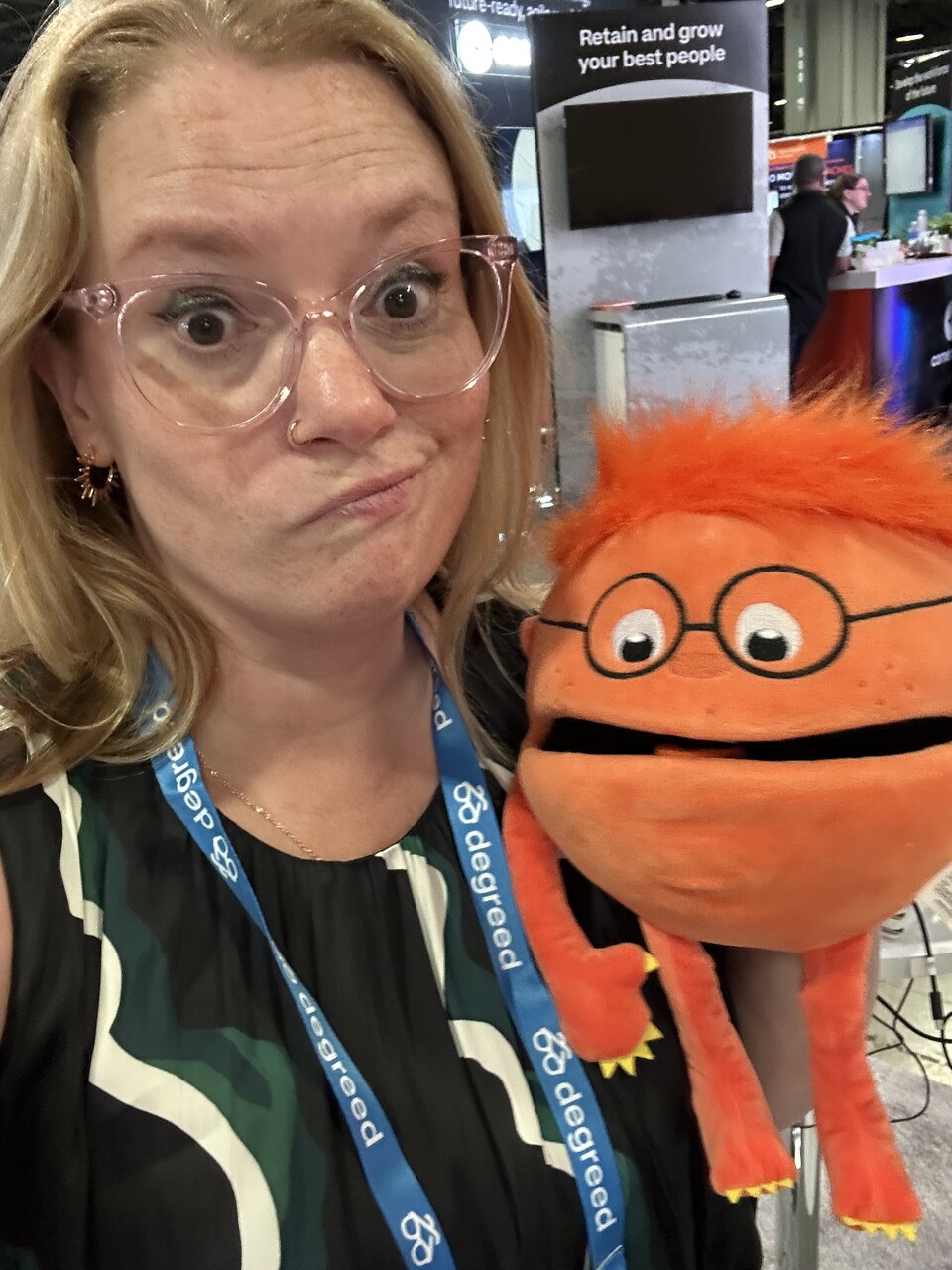
Okay. So this is my imposttor monster. Uh his name is Bernie. And those of you who are just listening, Bernie is a an orange uh bespeckled puppet. Uh his hair is a bit disheveled and he looks like he knows everything. Um and the reason I named him Bernie was because whenever I talk with him, I feel burnout and burn up. So, uh, so Bernie, Bernie is my imposter monster. And so, basically what I hear, what I feel when I'm having imposter syndrome is Bernie saying, and I imagine he has like a snively voice, something like, "This was a terrible idea." And you'll notice it's not that much different than my voice because if it was, would I listen to it? Probably not. Also, those of you who are just listening and not watching, he's kind of cute. Like, and the thing is like if our imposter monster was mean or scary or ugly, we wouldn't pay attention. But because he's kind of cute, we're like, "Well, maybe he's got a point."
[04:34]
That's so funny cuz like I do I I've not had that trick, but I do have my own little
[04:41]
way of personifying my imposttor monster. And actually, it's kind of like Mean Girls in high school.
[04:46]
Sure. Sure.
[04:47]
You wanted to be them. So, I kind of joke and call mine Rebecca.
[04:52]
Rebecca. There we go. Rebecca, Regina,
[04:55]
was one of the girls.
[04:57]
Yeah, absolutely.
[04:59]
Didn't think about it that way. That's really interesting.
[05:03]
Yeah. I mean, and that's the thing. I think we all have that and you you definitely have shown it, too. And Bernie is adorable. But
[05:11]
yeah, that's part of the problem is that he's adorable. It is part of the problem. So, it's kind of hard to get rid of him. I keep him around a little bit.
[05:17]
But has Bernie impacted your career?
[05:20]
Oh, yeah. Absolutely. um in a lot of different ways. You know, uh I I'll tell you this. I stayed at a job five years too long because of my imposttor monster. You know, one of the things that happens when you have imposttor syndrome is you forget who you are, right? You totally forget the things that you've done. It doesn't matter if you've kept the receipts. You don't look at them. You don't you don't balance the checkbook of you. Like none of those some the Jenz's are like, "What's a checkbook?" Sorry, you have to Google that later. But like you what we tend to do is we avoid the things that we should be doing because you know we we feel like oh well this is enough. We have sort of this fixed mindset right so you know over the years like this this one example I uh I worked for a bank for about 16 years and I was ready to go right around year 11. Um, it took me about a year of thinking it was time to move on and feeling bored at my job before I even updated my resume. And then it took even longer than that. Um, in fact, it took it took what I would say like almost like an act of an act of God, a universal act action against my life, uh, to actually make me apply for another job. Um, do you ever see the movie Office Space?
[06:41]
Yes. Yes.
[06:42]
Okay. So, you know, you know the guy that they they put in the basement.
[06:47]
Yes.
[06:48]
Yes. Yes.
[06:49]
So, what had happened was I had been in this job. I was beyond miserable because I was so underutilized. And um just to give you an idea, I'm I'm a learning uh solutions architect. So I spend a lot of time uh with clients developing like really intricate detailed leadership development programs that they can they can take to their organization at scale. That's the kind of work that I do. I spent five years running reports out of an LMS uh learning management system and doing pivot tables. See my eye twitching? Like this was the kind of work I was doing. And they basically what happened was they called everybody up and they were like, "Hey, we know you've been working remote for 10 years." This was like before working remote was cool, but no one's going to work remote now, so you have to come into the office. And I was like, well, I don't like it, but they are building a new office like 8 miles away, so I'll just go to that one. They were like, nope, you have to go to this one that's 25 miles away,
[07:46]
and we're going to put you in the basement. We're going to convert a supply room, swear to God, this really happened,
[07:52]
into an office,
[07:54]
and we're going to you're going to sit down there by yourself and run your reports and do your pivot tables. And that was sort of the catalyst that finally like was louder than Bernie. And I was like, I I need to do I need to do anything else but be in the basement with my red stapler. Uh you know, let's live in my life all alone in quiet. So um so yeah, so it's definitely impacted my career. Um, also like even before that, it it's really a lot of times people would say to me, "You're the best, Betty. You're the best." And I used to love that and be like, "Oh, that's that makes me feel so good." Like, that is so validating because I work so hard. And then after a while, I was like, "I'm the best at what? Showing up. What What am I the best at?" So I would try to be the best of whatever it was they were talking about because I suddenly had felt like they were manifesting that for me and I had to live up to that and it it it left me kind of like I said doing work that I didn't really enjoy and that really wasn't the best use of my time and talent because they kept saying I was the best. Oh, you're the best at running reports and pivot tables. Well, that's great. Doesn't mean that's what I should be doing. um just because I can do it and do it well. So, I would definitely say it's impacted my career. Um even still today, it will it will hold me back. I've done a lot of personal work to try to overcome some of that. But I still hear Bernie all the time, especially saying this was a terrible idea. Um and and sometimes, you know, sometimes maybe he's right, but I'm still glad I did it. Uh most of the time he's totally off base. He's not right at all.
[09:43]
Love it. Yeah.
[09:44]
Yeah. I love it. I mean, honestly, it's tough. It's tough because the unknown is so scary, right? That we let
[09:52]
that that voice get to us because we're at least the best at whatever the heck they're telling us we're the best at,
[10:00]
right? Exactly. Exactly. Yeah.
[10:04]
So,
[10:05]
it's funny. I used
[10:06]
I just I would tell you I used to get people used to say that because I'd show up with like donuts
[10:11]
and I was Oh. And then I was like after a while I was like, "Oh, I'm just the best at stopping to pick up donuts. Come on. I can I can be the best at something else. Anything else besides that."
[10:21]
But the donuts were a good excuse.
[10:22]
They were. I mean, I'm not I'm not complaining about the donuts. I'm just saying.
[10:26]
I mean, I think what makes me miss the office is just the donuts.
[10:29]
Yeah, it's fair. That is fair.
[10:31]
The thighs don't miss the office,
[10:36]
you know. Okay. So, you recognize this imposttor syndrome and it's holding you back and eventually you get free. Where's like maybe the turning point where you realize it's not just you?
[10:48]
Yeah. Yeah. So, uh about five Wait, wait, wait. It's 2026. So, six years ago, I started a podcast. Now, I want to make it very clear. I started the podcast before COVID. This was not my co hobby. Although it did become my co hobby hobby. I started it before then. In fact, it's so funny cuz I still remember when CO happened. I was like, I am not going to say the word CO on my podcast. That didn't last very long as you can imagine like three episodes and I had to say it because it was here forever. But, uh, but I started a podcast like like January of 2020, so a couple months before everything shut down. And um I was having conversations with some of these really amazing sort of high performers in the learning and development industry and about all different things like we talked about technology, we talked about using fandom in learning and development like all types of topics uh developmental topics for learning professionals and I kept hearing these high performers sort of describe the same thoughts that I had. So these are people with different titles, you know, different different backgrounds from all over the world, all sort of operating on the same script of I'm not enough. I don't do enough. It, you know, uh when are they going to figure out? I really have no idea what I'm doing. And like I started to recognize that this wasn't just a me problem. It's actually a pattern. And I started to continually ask these questions. And then I don't know, I was about a year into my podcast and I had been noodling the idea of I want to do a podcast about imposttor syndrome and I I actually was standing in line at the grocery store and I opened up my phone and I just dropped this quick LinkedIn post. Hey, I want to do an episode or two on imposter syndrome. You know, who wants to talk about this? And the the response was wildly overwhelming. The amount of people that were like, "Hey, yeah, me too." and and so and so that's kind of what started it and since then I've I've conducted like 50 official interviews and at least two or three times that unofficially with people just sort of as I've come across and we talk about it and the more technology changes the more I think we feel this way because people confuse the idea of being new at something with being capable of doing it and so there's a lot more of this sort of imposter syndrome that comes up I mean AI in and of itself has given me has just reignited. I mean, Bernie's got a whole new set of content thanks to AI, you know.
[13:32]
Yeah. They got a new playbook now.
[13:34]
Whole new playbook.
[13:35]
Yeah.
[13:36]
I love that because like I I'll say it this way. Like my biggest moment of imposter syndrome really is when I have to learn something new. Mhm.
[13:47]
It's like as if the learning new thing and at this point like we we cumulatively have a bunch of years underneath all of us and so it's like it's like come on you have learned so many new things your whole life why in the world do you let it bog you down right now?
[14:03]
Exactly.
[14:04]
But but the at that moment no I am not qualified at all for any of this which Yeah. I love that you brought that up because that really resonates there.
[14:15]
Yeah. So, here's the moment that we get a little bit crazy in is that
[14:22]
and then you're like our first guest. You get to experience it for the first time as a guest is our we're going to get uh unplugged
[14:32]
and uh we're going to do some rapid fire. So, first thing that comes to your mind um I'm gonna ask you a question. Just go. Okay.
[14:40]
Okay. So, what's one moment in your career where you felt completely underqualified, but you rocked it anyways?
[14:49]
Oh, just one. Okay,
[14:52]
just one. Sorry.
[14:54]
All right. So, the the first the first one the first one that comes to mind, and I've told this story a hundred times, so those listening, too bad. Here it comes again. But, um, sort of my first foray into speaking at conferences was about how to use augmented reality in your learning solutions. And that all came about because I was sitting in a in a meeting with my boss and her boss. And her boss said to me, "Hey, what are you guys doing uh that's innovative?" And I literally was like, "Well, sometimes we bring donuts to glass. Like, I don't I got nothing." And she was like, "What about something like augmented reality?" And this was like 2018, right? And I was like, "Sure, we could try that." And I literally walked back to my desk and had to Google, "What is augmented reality?" I had no idea. and it came up and I'm like this is Snapchat. what am I how am I going to teach insurance adjusters content through face filters? And that was a moment when I was like, why did I say yes when I hadn't even looked it up? And uh and that actually that was the catalyst that began sort of my love affair with emerging tech because I had to go and find out and I had to get new at something. And uh and so definitely that was a time when Bernie was like, "You should not have opened your big fat mouth." But I sure am glad I did because it changed the trajectory of my career and uh you know and my life really. So
[16:15]
Oh my god. Yeah, that's definitely crushing it.
[16:18]
Yeah,
[16:18]
definitely crushing it.
[16:21]
What's one tiny habit or mindset shift that helped quiet your imposttor syndrome?
[16:27]
He's really loud. Um just one. I'm going to give you two. You said it was tiny, so I'm going to give you two tinies. one we've kind of already said the thing that I think made the biggest difference in my life is knowing that I'm not alone that these feelings that I have and giving it a name
[16:44]
imposttor syndrome and then giving it a personality Bernie that is huge um another one sort of like a habit or a skill this is something that I have I have coached hundreds of people on is this idea of just say thank you and stop talking. So Joanne, we're going to do this with you and I have a feeling I know how you're going to answer this question. So if let's just say you just completed some project at work, you just did a a quick presentation on here's the results. Your your boss's boss comes up to you afterwards and says, "Hey, really nice job on that presentation." What what what would you say? What is your what is your first reaction when someone says, "Hey, great job." Oh, I already know. I I I tell all the reasons why it wasn't a good job.
[17:34]
Okay. Yeah. Oh, it was nothing. Oh, no big deal. See the handwave? The handwave. Here's what's happening in that moment. In that moment, when that person says, "You did a great job." Those words are floating towards you and you are literally smacking them away with your hand and you're like, it's like you're saying, "I don't receive that." And that's exactly what happens is you never receive it because you're too busy giving credit to somebody else. Oh, it wasn't it was a team effort. Oh, it was Even when you say something like I had a lot of fun,
[18:11]
that negates what they're saying. Instead, when you receive a compliment, say thank you and then shut up. Stop talking.
[18:22]
Love it.
[18:23]
Yes. Take the compliment. allows you to believe it, you'll be able to internalize it if you stop smacking it away. So, that's that's a tiny thing that can really make a huge difference with with your imposter syndrome.
[18:37]
Oh my goodness. I'm filing it in my head. Thank you.
[18:41]
Okay. Yeah.
[18:43]
If imposttor syndrome had a WhatsApp status, what would it say about you?
[18:49]
Oh, probably something like um online because I'm always online. uh fighting my imposttor monster with receipts because that's one of the things that you have to do is you got to pull out the receipts that prove you know what you're doing and remember who you are. So probably say something like that.
[19:10]
Love it.
[19:10]
Or maybe just buzz off Bernie. I don't know.
[19:12]
Buzz off Bernie.
[19:13]
Buzz off.
[19:14]
Yeah. I love it. Yep.
[19:17]
And I think we're getting close to the end and I want to make sure we give a really good takeaway.
[19:22]
Okay. And maybe the takeaway would be really what would you tell your younger self?
[19:29]
Oh, how young how much younger?
[19:32]
I you know what anytime because we have all different ages actually. What maybe even it is yourself today?
[19:40]
But what would you tell
[19:41]
Yeah.
[19:41]
someone actually let's rephrase it. What would you tell someone suffering from imposter syndrome? I would tell them, you belong here. No matter what your voice, no matter what you're hearing, you belong here. Because really, imposter syndrome is not it's not a mental health issue. It's a belonging issue. And I think that's that's something that as we start to keep talk, if we keep talking about it and we start realizing we're not alone, that's what makes such a huge difference because we actually do belong here. We do we did earn our seat regardless of whether or not you can remember it. Yes,
[20:20]
that's right. We do belong here. We've earned it
[20:23]
and we've gotten here. You have gotten here for everybody that's listening.
[20:27]
So, you know,
[20:30]
take the we got from Betty for, you know.
[20:33]
Yeah. Yeah.
[20:36]
Syndrome. Have a name for it. Tell her, him, whoever to just calm down.
[20:43]
Yeah. Just Yeah.
[20:45]
Just sit down. I got this. sit down. I got this
[20:48]
and I'm going to take the one is I'm going to take the compliment. Take the compliment.
[20:53]
Thank you. Yeah. Yeah. I think that's a great key takeaway from here, right? Like you belong in the position that you're in. Whatever you're doing, you belong there. So that's a very key takeaway.
[21:06]
Well, thank you so much, Betty, for coming onto our show, being our first official guest.
[21:12]
Yes.
[21:13]
It's always very exciting there.
[21:14]
I'm so excited. Yeah.
[21:16]
And um I'm going to hand it back actually to Vimala to help close up the show.
[21:22]
Yeah. Thank you so much, Betty. I was uh making some mental notes as you were giving some key takeaways there. Whatever tenure you are in, you always have that imposttor syndrome
[21:34]
person. Giving that a name is also a good takeaway. I I don't think I have a name for my imposter syndrome. Um so definitely we'll work on it and uh thank you so much you have so you definitely kind of helped us understand what uh the imposter syndrome is broke you did break it down to like key key elements that we can take away and thank you for being our first guest and
[22:02]
thanks so much for having me.
[22:03]
Yeah and also being unplugged and giving some real answers there.
[22:08]
You bet.
[22:09]
All right. Thank you so much and um we'll have our next episode coming up soon in March. Uh we'll also have a panel with Betty um maybe in couple of months once we have few guests. We want to bring all the guests together, do a panel and we'll take some questions from the audience at that time too. So thank you so much. Thanks again. Thanks for all the tidbits that you have given us. And uh Joanne, anything else to close up?
[22:35]
Just everybody stay unplugged.
[22:38]
Yes. Love that.